Wednesday, November 30, 2005

The Wide World of Geophysics

Geophysical Survey has become sort of my love child just within the past few months of taking Geological Science 782: Magnetometry with Dr. Ralph von Frese (isn't he cute with that hat!) and doing my own Magnetic Survey.

Ralph is an inspiration because he started on an archaeological site for his MA (circa 1970) at Ft. Ouiatenon in Indiana. He used, what are now somewhat out-dated geophysical methods for archaeological sites, but discovered many important anomalies nonetheless, including hearths and burials. Ralph has all the mathematical smarts to really understand the magic behind the magnetics. I am trying really hard in this class, but it is all pretty much over my head.

For this reason, I wanted Dr. Jarrod Burks to come into my class and explain to the geologists and math whizzes what he does on archaeological sites with the FM 36 Fluxgate Gradiometer (the same instrument I use). He has little to no math/physics or geology background, but has made a living doing this stuff with his consulting firm. Like me, he describes himself as an archaeologist first.

Jarrod spent an hour and a half talking about his methods of data collection, processing, ground-truthing and interpretation. He had everyone, including me inspired and in awe. He perfected his survey techniques with a bit of trial and error and lots of practice and with the pressure to get better or face being out of business.

I got the opportunity to go to lunch with Ralph and Jarrod before the talk. It was very interesting to watch the Old and New School geophysicst-dynamic play out. I think Ralph had a few misconceptions about who Jarrod was and what he did, but by the end of it all, Ralph was also inspired. Yesterday in class, Ralph spent the better part of the first half-hour talking about Jarrod's techniques that he has them "perfected".

I'm glad this all happened before I have to present on my mag project on the work I have been doing Hopewell Mound Group next week. It gives me more validity. I think Ralph and the rest of the class have a much better understanding of archaeological geophysics and a much better appreciation for it.

I realized just how much I liked what I was doing while I was explaining things to my good friend and mentor David Pettegrew, an Ancient Historian/Classical Archaeologist, for whom my thesis is dedicated. Since he's back from Greece for just a bit, we met for coffee and had a long talk about being an archaeologist and what kinds of things we must face once we get out of grad school. I blabbed on and on about the skills I am gaining in mag survey. He seems real proud of me, and will be damned if I don't get into my school of choice this time around.

I then got my chance to talk magnetics over some food with my new friend and helicopter pilot named Don. So much for first impressions. I couldn't contain the progression of my thoughts as I ventured down the path of magnetic survey and what it was like trying to become a geoarchaeologist. Well, he seemed impressed, but maybe it was just shock and utter confusion. He did have some input on airborne magnetic survey though.

All in all, this stuff is too much fun to quit. I love the challenge of it and the interpretation. What to do, what to do....

Well, for starters, the Midwest Archeological Center hosts Geophysical workshops every year. Last spring, it was held in Chillicothe, but I did not get to go because it was nearly 500 bucks, and the Park Service would not pay my way. In 2006, it will be held at Fort Frederica National Monument,
St. Simons Island, Georgia. Perhaps I will be able to get funded to go this time around. Any suggestions?

This location was brought to my attention by a grad student at Arkansas, who read my blog. I think I'm going to have to consider going to school there now because of all the opportunities he has told me about working with Ken Kvamme in geophysics.

My visit to the University of Pittsburgh went really well, where I met Mark Abbott, Mike Rosenmeier and Bill Harbert as well as a slew of graduate and undergrad geology students. Bill is the geophysicist there and had lots of good advice for me. I'm definitely applying there to work on the geoarchaeological sites Mike has funding for, and perhaps I'll get to use the gradiometer that they are allowed to borrow from the Pittsburgh Dept. of Energy.

I'm taking off for the University of Kansas tomorrow to visit Jack Hofman and Rolfe Mandel. Rolfe actually works for the Kansas Geological Survey and runs a Geoarchaeology field school, so I'm hoping there will be some good opportunities there for me.

I'll let everyone know how it went when I get back!

Wednesday, November 16, 2005

Integrated data processing for archeological magnetic surveys

The SEG, or the Society of Exploration Geophysics, publishes a journal called The Leading Edge. Within this journal is a section called "The Meter Reader", which intends to update members on "the latest developments in potential-fields geophysics". One of the articles from this month pertains to my interests in the application of magnetic survey techniques in the Mediterranean. Integrated data processing for archeological magnetic surveys, includes a fantastic example of using geophysics to locate tombs in Italy.

If you are interested in the field of geophysical survey, not just in Mediterranean archaeology, but in it's many geological, archaeological and engineering applications, I strongly urge you to become a member.

Thursday, November 10, 2005

Statement of Madness...

...Formerly known as the Statement of Purpose. Feedback from peers and trusted professors is key. After several drafts of last years statement of purpose, I have come up with this:

Laura Renee Murphy Arizona State University, Archaeology

Statement of Purpose

Over the last several years at Ohio State University, I have become increasingly interested in understanding the dynamics between humans and the environment through the use of archaeological and geological methods. My initial interest in this topic developed through the history department as I explored Greek and Roman civilization. I found it invigorating that scientific methods in the field could be used as a tool for understanding the past, so I began taking more course work in archaeology and geology. It was while taking advanced geology courses that I discovered my natural ability for working in the field and deciphering the past through scant evidence left in the earth. Subsequent ancient history and anthropology courses opened up my interest to the questions currently sought in Mediterranean and prehistoric archaeology, particularly those pertaining to settlement patterns, trade, and the development of agriculture.

My academic studies and field experience have prepared me to pursue these issues in graduate school. In March 2004, I journeyed to San Salvador, Bahamas, to study and interpret past geological and archaeological landscapes. In summer 2004, I participated in a ten-week field school, where I learned the scientific techniques and basic methodologies of archaeology by surveying and excavating on a prehistoric Hopewell Culture site near Cedarville, Ohio. With an Undergraduate Research Grant, I traveled to Corinth, Greece, to collect original data vital to my senior honors thesis. The thesis, defended May 27, 2005, critically evaluates the methods of intensive data collection of the Eastern Korinthia Archaeological Survey (EKAS) in order to foster change and push for survey consistency in the Mediterranean.


Throughout college, I volunteered countless hours in the preservation office of the Ohio Historical Society, cataloguing prehistoric artifacts and teaching school groups about archaeology. After graduation, I began working at Hopewell Culture National Historical Park as a Park Ranger and Archaeological Aid, gaining skills in prehistoric interpretation, education and geophysical survey. I have served as a supervisor for historic excavations with groups of Boy Scouts and conducted countless educational programs for the public. Recently, I have collected data with GPS and geomagnetic survey at another prehistoric Hopewell Culture site. These have been valuable experiences in supervising, teaching and using new methods of data collection.


I have been fortunate this year to have enough flexibility in my schedule to continue my education at Ohio State while working for the Park Service. I have complimented my undergraduate history and geology course work by taking Latin and Greek as well as a few anthropology courses. This year, in preparation for graduate school, I am continuing with Latin and Greek while taking both graduate level geology and cultural anthropology courses. By the end of the academic year, I will have studied Latin for three years and Greek for two, and I will have added 25 credit hours in anthropology in topics such as cultural ecology and skeletal biology.


My research interests include studying landscape dynamics and geomorphology, or how the changing landscape influences cultural settlement, trade and agricultural intensity. To compliment this, I would like to continuing studying current methodological practices and understanding how geomorphology influences artifact densities and recovery rates in surface collections. I am also interested in creating parameters, developing, and using GIS models to aid archaeological discovery and interpretation. My geology minor, field and research experience, and ability to use Geographical Information Systems, Surfer 8, GeoPlot, and GM-SYS allow me the flexibility to study such complex topics as well as collect and interpret data on archaeological sites in any environment or location.


I am pursuing graduate work in anthropology at Arizona State not only because I think my specific scholarly interests are consistent with those of the faculty, but also because the many facets of the LLSMB project allow me the flexibility to explore the prehistoric Mediterranean world from both archaeological and geological aspects. While my goal is a doctorate and a research position in the field, I hope to take the time to explore a variety of prehistoric cultures from many different archaeological and geological perspectives before settling on a specific topic. Arizona State is appealing in that the inter- and multi-disciplinary aspects of the program will allow me the flexibility to explore and grow as an archaeologist using a wide range of new technology and tools.

-------------------

The question is: do I mention the names of professors I want to work with?????

In a previous draft I mentioned Michael Barton, Kate Spielmann and Chris Carr by simply pointing out the fact that their work is interesting and follows my own interests. I have gotten advice to take the names out: my interests can be matched with professors, leaving the options of several professors open. Other advice says to really point out that you know the profs and what they are doing.

The only other advice: "make the statement interesting". I'm not sure what that means...

The heat is on!

Wednesday, November 09, 2005

Back in the Saddle Again: Mediterranean Geoarchaeology

Today was a day of confidence boosts, just in time, I might add. 9 November 2005 I climbed back on the saddle proudly. In the weeks leading up to today, I merely had one foot in the stirrup trying to figure out how the hell I was going to jump on--uncertain of which way I wanted to go with round two, year two of the graduate application process. After last year's dissapointing outcome of rejections and acceptances without funding, I have been apprehensive about going through the heartache all over again. But this is what I want to do. This is MY quest. I needed to step it up, pronto!

In a furry of morning college searching I discovered several graduate programs in Mediterranean Geoarchaeology that went undetected last year. A half-dozen or so emails later, I was back in the game.

The Arizona State University application has been a certainty since the summer. It's my top choice, but I'm realistic about my chances: slim to none of getting in. ASU's Anthro program is highly competitive and I was not an Anthropology major.
Disadvantage Laura: 1.

Let's accentuate the postive though, shall we?

Advantages:

I visited the school and department this past summer and met with faculty, staff and students.
Interdisciplinary studies are becommming more and more popular, esp. with ASU.
My background is solid with classes in Ancient History/Classical Archaceology, Geology, Anthropology and Classics (Latin and Greek).
I have an archaeology field school.
I know how to use GIS/GPS, GM-SYS, GeoPlot and Surfer.
I know how to operate and understand the principals behind the Fluxgate Gradiometer.
I did a senior honors thesis based on the independent research I did in Greece.
I'm taking graduate level courses at present.
I could easily do a thesis on the Ohio Hopewell or Mediterranean Landscape Dynamics, meaning I could work with a variety of people at ASU.
I have catalouged artifacts.
I was a historic dig supervisor for Boy Scouts.
I have performed field work in the Bahamas, Greece and Ohio.
I already have my degree, and will have spent a year with the National Park Service doing interpretive programs and archaeology.

At least I hope these are advantages.

With ASU I want to help in the field and with data crunching and GIS modeling for the LLSMB Project. Be sure and check out this link. This project is exactly inline with my interests and research goals. This is the place I want to be.
Sunny Tempe, Arizona.

With ASU not at all a shoe-in, and OSU out of the picture, unless I can convice the Geology chair to create a Geoarchaeology program, I needed to come up with just a few more options.

I would have never thought to look around in Kansas. Check out this professor:

Rolfe D. Mandel Associate Professor, Archaeology Associate Scientist, Geoarcheology / Quaternary Geology
Ph.D., University of Kansas 1991
Research Areas: Geoarchaeology, landscape evolution, geomorphology, paleoenvironmental reconstruction; Great Plains, Midwest, Mediterranean, Gulf Coastal Plain.

His reaserach areas are exactly what I'm interested in persuing.... I emailed him but haven't heard back yet.

The most exciting endevour was my discovery of and contact with Mark Abbott at the University of Pittsburgh.
I emailed Mark and told him my interests:

Dr. Abbott,

In my quest to find a grad program fit for my broad interests in geomorphology and archaeology, I came across your name.

My background at OSU is in Ancient History-Geology-Classics-Anthropology. In other words, Mediterranean Geoarchaeology, with field work and my own research and data for my senior honors thesis collected in the Eastern Korinthia, Greece.

My research interests for grad school include studying geomorphology, or how the changing landscape influences artifact densities in surface collections, or in general, how geomorph influences cultural settlement and agricultural intensity. I also have a keen interest in studying paleohydrology from both a geologic (reconstructing past landscapes) and archaeologic (ancient stream divergence, agricultural use).

Perhaps you could tell me a bit more about your interests and if you are taking on more grad students for this coming fall. If so, I would like a chance to compete for a spot. Perhaps you have other suggestions of potential professors to work with. Thanks for your time! I look forward to hearing back from you.

Sincerely,

Laura R. Murphy
-------------------

He responded immediately, recommended I contact Dr. Michael Rosenmeier and recommended that I give him a call and visit the campus on a Friday. So I called Mark and we set up November 18th as my visitation date. I'll be staying with a grad student who works with Rosenmeier and I'll be able to meet both professors, attended a few meetings and classes, and meet other students.

If accepted at Pittsburgh, it's most likely I would formulate a co-advisor program between Mark's geologic work and Michael's program in Greece: Third Millennium B.C. Abrupt Climate Change and Social Collapse in Greece and the Aegean. Right up my alley, eh?
I can't say enough how much I appreciate Mark's enthusiasim and response to my email and I look forward to visiting!

The next thing on the agenda for the day was a visit with Dr. Sam Meier from OSU's Near Eastern Languages and Cultures department. I wanted an outside opinion and his advice on graduate school. After a brief Q and A about the Hopewell and the Park, I launched into my graduate school struggles and troubles over the past year. He gave me excellent advice on how to structure my new Statement of Purpose, and told me to start searching for new field opportunities for this summer to round out my experiences.

I good day I would say and it's not over yet. I have time to make more progress before it's through.

Sunday, November 06, 2005

Let's Get Geophysical!


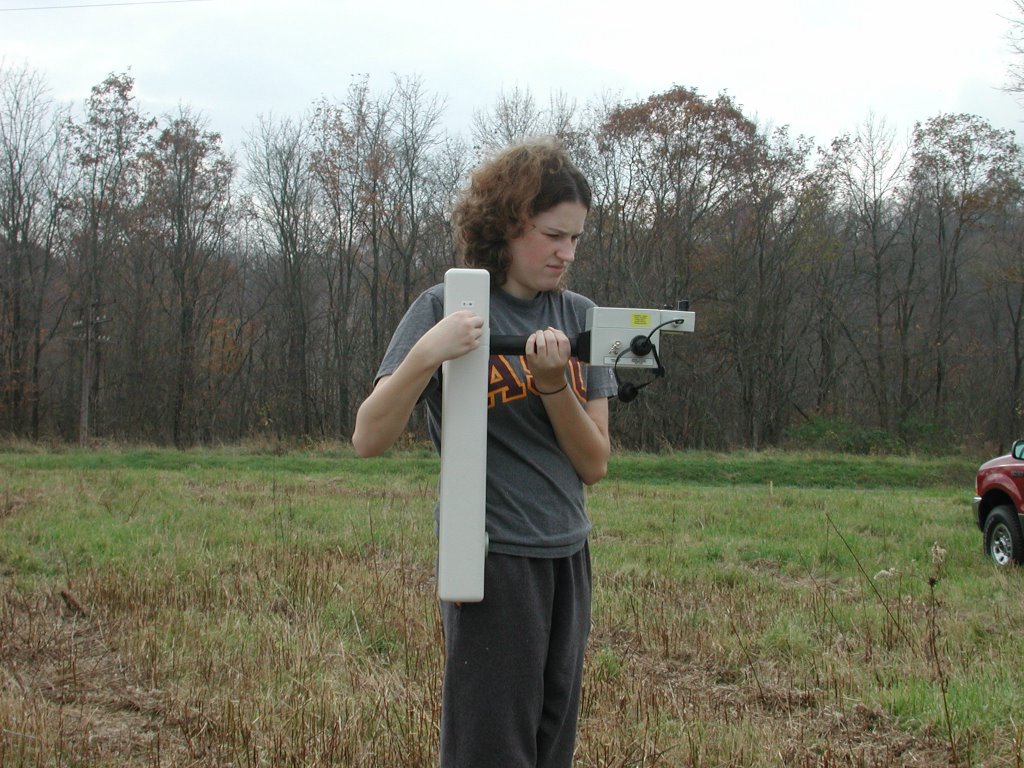
With my graduate level Magnetometry Class deep into the quarter, it was high time for me to start getting geophysical. My end of the quarter project is going to be on the data that I collect with the FM36 Fluxgate Gradiometer (left) out at Hopewell Mound Group. This is one of 5 large Hopewell Earthwork sites protected by Hopewell Culture National Historical Park where I work as a Park Ranger.


Out of uniform and clad in non-magnetic attire, I scanned 11 10 by 10 meter units in two Saturdays. Using GeoPlot and Surfer 8 to look at my data, it seems that I have a couple of promising prehistoric anomalies, a few hunks of metal, some strange looking dipoles and what looks to be plow scars though they are curving at an odd angle.

The area that I'm scanning is a part of the Hopewell Mound Group Trail 2005 Project. We are required to survey and shovel-test portions of this large ceremonial site before we do any kind of construction, such as putting in a new hiking trail.

I don't know what all of my data means just yet. It's going to take a lot of hours spent in the lab for the next month in order to figure some of it out. Hopefully the additional data I will collect the rest of the Saturdays in November will help. It's a tough task, but I know I can do it.
--------------------------
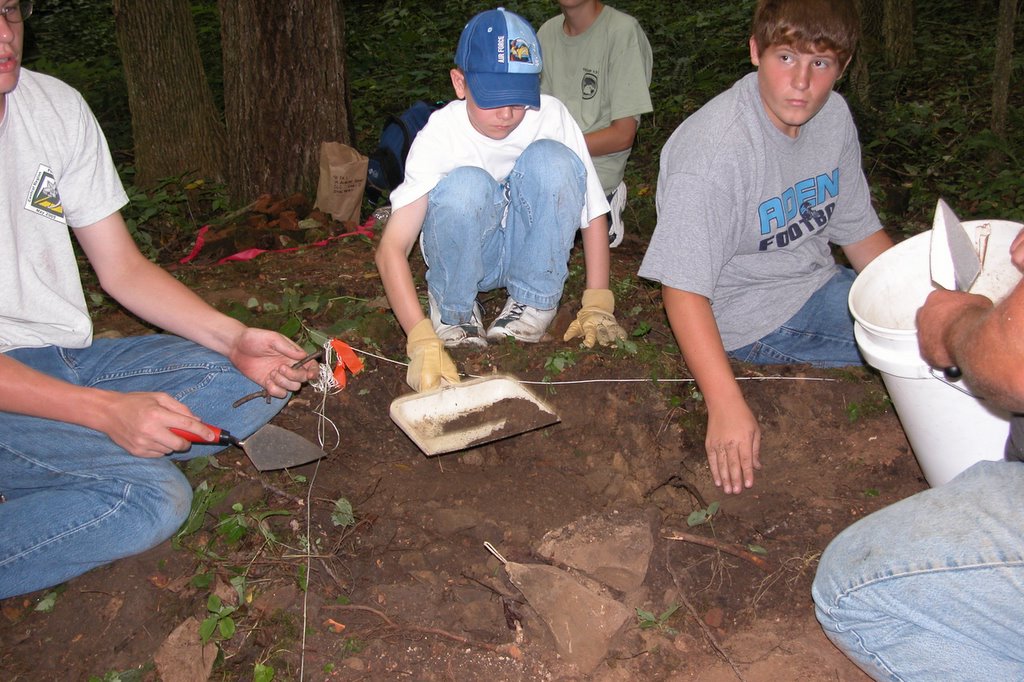
In previous posts I have talked about my Archaeology Merit Badge program for the Boy Scouts at the Park. I thought I would add a few pictures to my site since I have them ready. I'm still hoping to obtain a hefty amount of grant money to continue the merit badge program full time over the summer. Cross your fingers for me.


I received a trowel with all of the scout signatures on it!


Two Scouts work on mapping the unit.


Some scouts excavate unit 1.


Me pictured with Eagle Scout Chris Bungard.